
Acoustic treatment and soundproofing are often discussed as if they are the same job. They are not.
Acoustic treatment improves sound inside the cinema room. Soundproofing—or sound isolation—reduces sound travelling between the cinema and the rest of the building. A well-designed home cinema may need one or both, depending on its location and how it will be used.
What acoustic treatment does
Sound reflects from walls, the floor and the ceiling. When strong reflections reach your ears shortly after the direct sound from the speakers, dialogue can become less clear and effects can feel harsh or unfocused.
Acoustic treatment manages those reflections. Common tools include:
- broadband absorption panels
- bass traps
- diffusion
- heavy curtains where appropriate
- carpet and upholstered furniture
- strategically designed wall and ceiling finishes
The aim is not to cover every surface with soft material. A cinema that absorbs too much high-frequency energy can sound dull while still having uneven bass. Treatment should be placed according to speaker positions, seating and room behaviour.
What soundproofing does
Soundproofing attempts to limit sound transmission through walls, doors, ceilings, floors and ventilation paths. Low-frequency bass is particularly difficult to contain because it carries energy through the building structure.
Effective isolation may involve:
- additional wall or ceiling mass
- separated or decoupled construction layers
- carefully sealed gaps and penetrations
- solid, well-sealed doors
- isolated treatment of ducts and ventilation paths
- attention to structural paths through floors and adjoining walls
This work is most effective when designed before the room is finished. A decorative panel placed on an existing wall may improve reflections inside the room, but it will do little to stop bass reaching a nearby bedroom.
A simple way to remember the difference
If the problem is echo, unclear dialogue or uneven sound in the cinema, think about acoustic treatment.
If the problem is family members or neighbours hearing the film outside the cinema, think about sound isolation.
If both problems matter, the room may need both systems planned together.
Does acoustic foam soundproof a room?
Lightweight foam can absorb some higher-frequency reflections, but it does not add the mass or structural separation needed for meaningful sound isolation. It may change how a clap sounds inside the room while doing very little for sound passing through the wall.
Foam also needs to meet suitable safety requirements for the intended interior application. Do not cover a room with an unknown material simply because it is sold with a wedge pattern.
Why bass needs special attention
Small rooms develop strong low-frequency peaks and dips. A seat may have overwhelming bass while another seat only a short distance away has very little. Moving the subwoofer or seat can sometimes make a larger improvement than increasing power.
Bass treatment, multiple subwoofers and electronic calibration can all help, but they address different parts of the problem. Their selection should follow measurements and the room layout.
Isolation of bass is a separate construction challenge. It requires controlling vibration and transmission paths, not only improving the frequency response at the seats.
When should isolation be considered?
Sound isolation deserves early attention when the cinema:
- shares a wall with a bedroom or study
- sits below or above a quiet room
- is close to a neighbouring property
- will be used late at night
- includes powerful subwoofers
- is part of a new build where structural work is still accessible
Expectations should be discussed honestly. Complete isolation at very low frequencies can require substantial construction, space and cost. The right target may be reducing disturbance rather than claiming the room will be completely silent outside.
Doors, windows and air paths matter
Sound will use the easiest path. A carefully built wall can be undermined by a lightweight door, an unsealed frame, a window or a direct ventilation opening.
At the same time, the room still needs fresh air and cooling. In Sri Lanka, sealing a cinema without a suitable ventilation and air-conditioning plan can make it uncomfortable and place equipment under unnecessary heat stress.
These details are why isolation should be coordinated with the complete room design.
Plan treatment after the layout
Acoustic decisions depend on the final positions of the screen, speakers, subwoofer and seats. Finalise the main layout before deciding where panels will go. Treatment can then be integrated into a clean interior design instead of appearing as an afterthought.
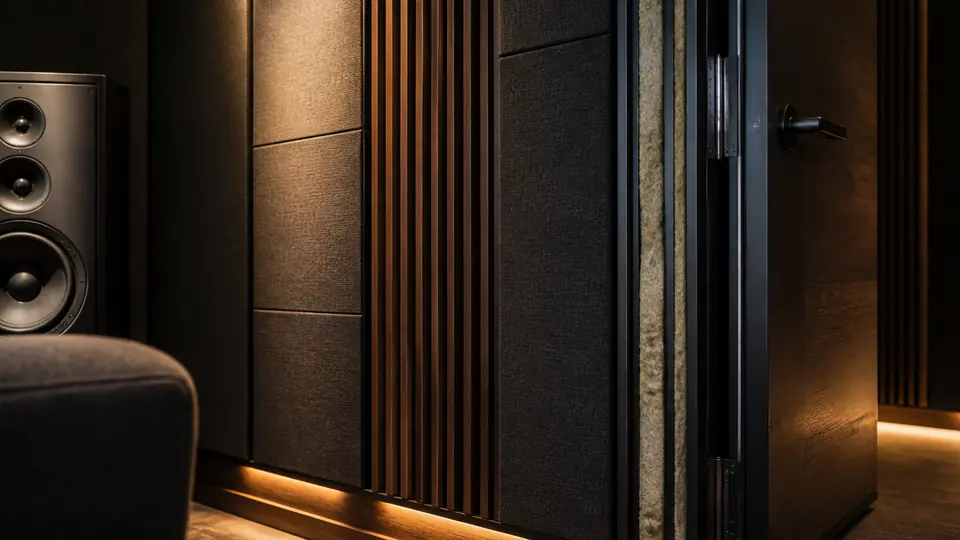
Fabric-covered wall sections, timber details and concealed treatment can make a room feel refined while performing a technical purpose. The visible design and acoustic design do not need to compete.
Cinema Builders plans acoustics as part of the complete cinema room—not as a collection of random panels. Contact us with your room details to discuss the level of treatment or isolation your project may need.